

The Matenadaran officially the Mesrop Mashtots Institute of Ancient Manuscripts,
is a museum, repository of manuscripts, and a research institute in Yerevan, Armenia. It is the world’s largest repository of Armenianmanuscripts.
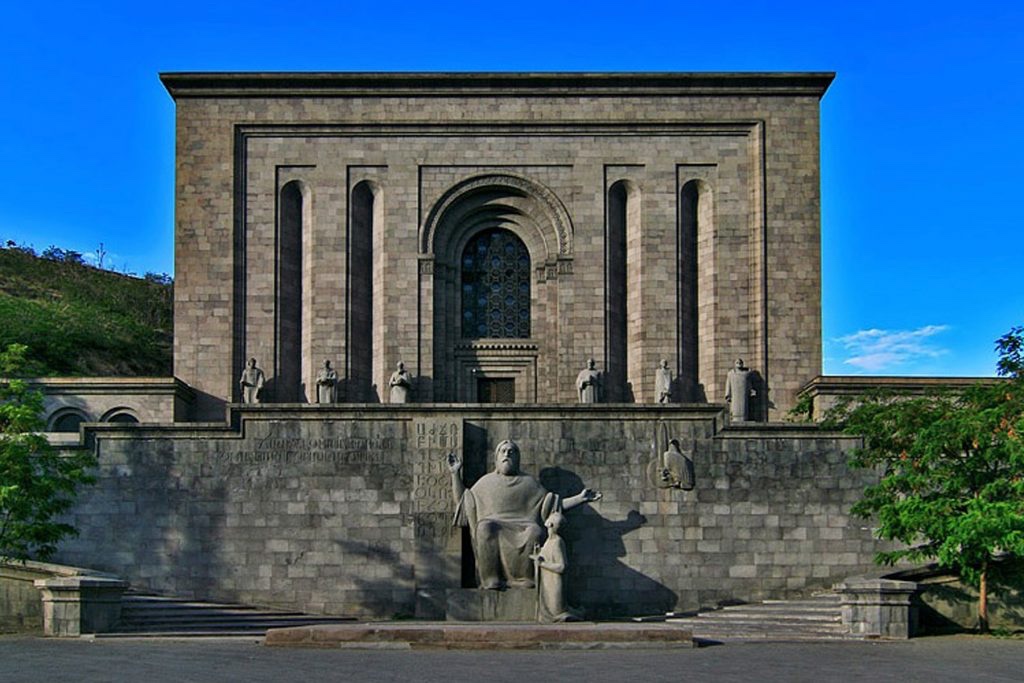
It was established in 1959 on the basis of the nationalized collection of the Armenian Church, formerly held at Etchmiadzin. Its collection has gradually risen since its establishment, mostly from individual donations. One of the most prominent landmarks of Yerevan, it is named after Mesrop Mashtots, the inventor of the Armenian alphabet, whose statue stands in front of the building.
The word «matenadaran» in translation from Armenian means a repository of manuscripts. The Matenadaran Institute was created on the basis of the collection of Echmiadzin Monastery manuscripts nationalized in 1920. The beginning of the creation of this collection dates back to the 5th century and is associated with Mesrop Mashtots (c. 361-440), the creator of the Armenian script. Already in the 5th century, Lazar Parpetsi reported that there was a book depository at the Echmiadzin Monastery In 1892 the collection consisted of 3158 manuscripts, in 1897 — 3338, in 1906 — 3788, in 1913 — 4060.
The Echmiadzin Matenadaran was declared state property on December 17, 1929. In 1939, the collection was transported from Echmiadzin to Yerevan. The modern building of the Matenadaran was built in 1959 according to the project of the architect Mark Grigoryan In 1984, the first volume of the general catalog of the Matenadaran collection was published.
 Մարկ Հարությունյան