

As in the case of many other complex, systemic inventions, the development of the idea of an electric car and its design took place in several stages, so it is very difficult to say when the first electric car was created and to single out the inventor who made the main contribution.
The first patent for an electric vehicle was issued already in 1799 in Great Britain [1], but this was only an idea, not a workable design, because the current source and electric motor had not yet been created. But a year later, thanks to the efforts of the Italian physicist Alessandro Volta, a current source appeared — the famous «voltaic pillar» — a primary chemical current source, consisting of more than a hundred copper and zinc plates, separated by cloth, which was impregnated with acid. Like modern batteries, the plates required periodic replacement (they dissolved). The very first electric vehicles received such batteries.
The principle of converting electrical energy into mechanical energy was shown by the British scientist Michael Faraday in 1821 in an experiment with a free hanging wire dipped in mercury. A permanent magnet was installed in the middlebaths with mercury. When a current was passed through the wire, the wire spun around the magnet, indicating that the current was causing a cyclic magnetic field around the wire. The development of this experience became a unipolar motor — Barlow’s wheel — a demonstration device that is of little use for practical use.
In an effort to create an electric motor for solving practical needs, the designers tried to imitate the principle of operation of a steam engine — the engine armature performed reciprocating movements. Scientist Boris Yakobi (Russia, Prussia) took a different path, creating in 1834 the world’s first practically usable electric motor with a rotating armature and published a theoretical work «On the use of electromagnetism to drive a machine.» With this invention, everything was ready for the creation of an electric vehicle.
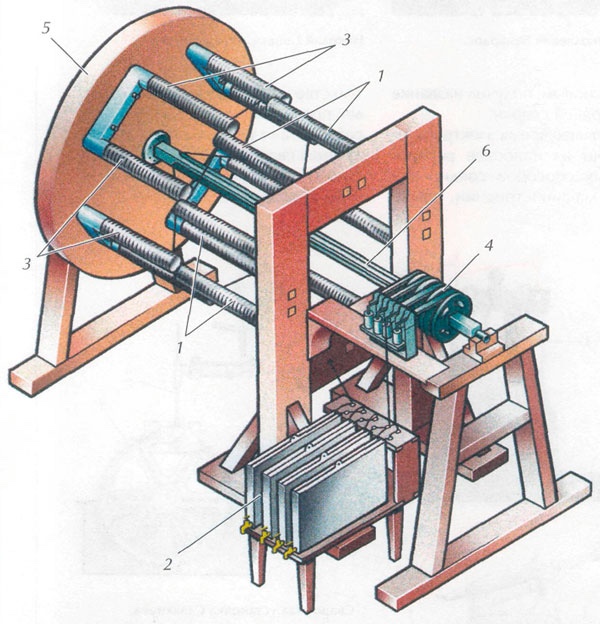
Fixed group of U-shaped magnets (1) — the stator is powered by current directly from the galvanic battery (2); the direction of the current in the magnets remains unchanged. Movable group of electromagnets (3) — the rotor is connected to the battery through a commutator (4), with the help of which the current in the magnets and, therefore, their polarity change eight times during one revolution of the disk (5). Moving magnets are alternately attracted and repelled from the stationary ones, and the motor shaft (6) begins to rotate. The motor power is about 15 W.
And the appearance of the world’s first electric car was not long in coming: in the early thirties of the XIX century (the exact date is unknown), the Scotsman Robert Anderson built an electric model, which is considered the first in history. In 1835, the Dutch professor Sibrandus Stragingh and Thomas Davenport from Vermont (USA) made another electric car model. In 1842, the Scotsman Robert Davidson and the same Davenport built cars that were no longer models, but could carry people [2]. The electric motor in the cart was powered by acid batteries (huge baths with sulfuric acid) [3]. Davidson’s carriage was extremely slow, huge and clumsy, which, however, was typical of most road vehicles of the time.
A significant impetus in the development of electric vehicles was the invention of the lead-acid battery by the Frenchman Gaston Planté in 1859. Operating electric vehicles with rechargeable batteries was much more convenient than replacing zinc plates. So in 1881, the electric tricycle of Charles Jeanteau (the inventor of the steering linkage) drove onto the roads of Paris, and in 1888 Ratcliff Ward launched an electric omnibus through the streets of London, starting the commercial use of electric vehicles. Note that the tram appeared in 1881, and the trolleybus — in 1882.
In 1889, engineer Ippolit Romanov created the first Russian electric car. A feature of Romanov’s two-seater electric car was its low weight. It weighed only 720 kg, while the Zhanto electric car weighed 1440 kg.
On May 1, 1899, in the town of Asher, near Paris, the Belgian racer-inventor Camille Zhanatzi brought to the start a homemade electric car «La Jamais Contente» (French for «Always dissatisfied»). It was in the shape of a projectile, the total power of its two electric motors was 50 kW (67 hp), and it was “shod” in pneumatic Michelin tires. The batteries were located on the chassis inside the body and on the rear axle. The maximum current strength is 250 A at a voltage of 200 V. The curb weight was about 1000 kg. Zhanatzi created the first car to overcome the 100-kilometer speed limit with a result of 105.9 km / h. This could not but contribute to the popularization of electric vehicles.

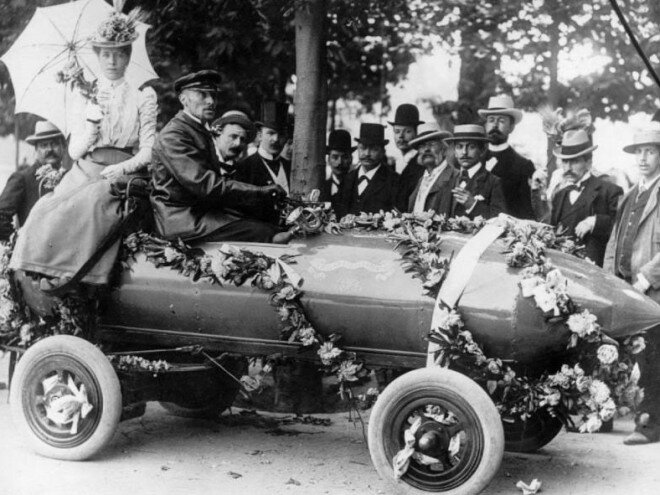

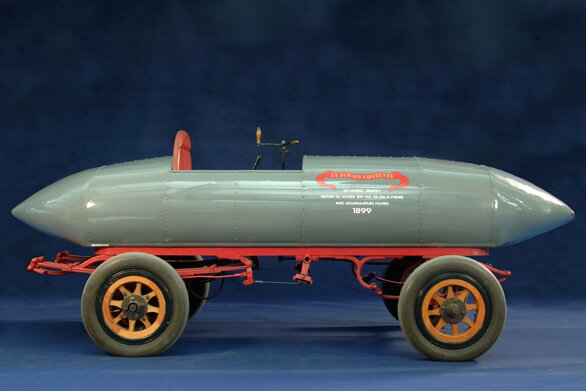
The first to overcome the speed of 100 km / h on land.
As a result, by 1900, more than half of the cars (including almost all taxis) registered in the United States were electric. However, by 1910, there were less than 1% of the total number of electric vehicles.
 Մարկ Հարությունյան