A. 1) It was a terrible accident. How many people were killed?
2) Tomas fell off his bike yesterday, but he wasn’t injured.
3) We didn’t play well yesterday. We we’re beaten 4-0!
4) When the volcano erupted, the noise was heard 200 kilometers away.
B. My grandparents live in the countryside, in an old cottage. It’s got a bedroom, a bathroom, a living room and a kitchen. The bedroom and the living room are quite big, but the kitchen’s very small! I love old cottages like our grandparents’.
C. 1) I couldn’t finish the test because there was not enough time.
2)I feel sick – I think I’ve eaten too much chocolate!
3)I didn’t really enjoy my visit to Rome because there were too many tourists everywhere.
D. 1) I’ve put some old clothes on because I will wash my dad’s car for him.
2)What time are we going to meet John this evening?
3) Please can you lend me some money? I promise I will pay you back by Friday.
E. Underline the odd one out
1 bungalow garage cottage flat – flat
2 flood earthquake tsunami bomb – bomb
3 TV aerial semi-detached house chimney gate – semi-detached house
4 caravan terraced house bungalow detached house – caravan
F. 1) Lots of people lost their lives when the volcano erupted.
2) People living in the Caribbean are somtimes hit by hurricanes.
3) The catastrophe caused a lot of damage and eventually the government had to help.
4) This information is essential for people who live in areas with lots of earthquakes.
5) We didn’t watch the match – there was a problem with the TV aerial.
Easter is a Christian festival which marks the resurrection of Jesus Christ. For many Christians, Easter is a celebration of the triumph of life over death, and a very important time of the year. Many non-Christians also have a holiday at this time, so it is a popular time to travel or spend with friends and family. We see lots of symbols of new life at Easter, especially eggs, chicks, flowers and rabbits. These symbols go back to ancient pagan traditions which celebrated fertility, rebirth and new growth after the long, winter months.
WHEN IT IS CELEBRATED
The dates of Easter change from year to year but it usually falls sometime between the end of March and the end of April. In Western Christianity, Easter Sunday is the first Sunday after the first full moon of spring, which starts on 21 March. The Eastern Orthodox churches, which use a different calendar, have a slightly different way of calculating Easter and usually celebrate Easter a little earlier or later.
HOLY WEEK
The week before Easter is called Holy Week. The first day of Holy Week is Palm Sunday, which is the Sunday before Easter. Many Christians celebrate this as the day that Jesus entered Jerusalem and people threw down branches from palm trees on the road to welcome him. Four days later is Maundy Thursday, which marks the Last Supper, when Jesus ate bread and drank wine with his twelve disciples. The following day is Good Friday, which is significant for Christians as the day that Jesus was put to death on the cross. Many Christians believe that Jesus was killed and buried in a tomb on the Friday and that God raised him from the dead on the Sunday. So Easter Sunday is a celebration of the resurrection of Jesus.
HOW EASTER IS CELEBRATED
In many countries there are religious processions during Holy Week, and practising Christians attend special church services. On Palm Sunday, many churches bless palm branches and people put them on the ground during processions to mark the day that Jesus arrived in Jerusalem. The Last Supper on Maundy Thursday is celebrated in many Christian traditions in the form of the Communion, when believers share bread and wine. Good Friday is traditionally a day of fasting, reflection and sadness. A lot of church services start at midnight the night before Easter Sunday with the lighting of candles or, in Greece, fireworks. This represents the triumph of light over darkness. On Easter Sunday, churches are filled with flowers representing new life, and at home chocolate Easter eggs are given as presents.
OTHER EASTER TRADITIONS
There are many different Easter traditions around the world. In some places, people eat lamb on Easter Sunday, but there are many other foods, such as hot cross buns – spiced, sweet bread buns made with raisins – that are traditional in the UK.
In some places in Eastern Europe, boys and girls throw water at each other, while in Corfu, Greece, there is a tradition of throwing pots and pans out of windows and from balconies, breaking them on the street. In the United States, a tradition of wearing new clothes at Easter has evolved into making Easter bonnets – fancy hats decorated with flowers, rabbits and other symbols of spring. For fans of crime fiction, Norway is the place to be at Easter, when it has become traditional to read crime novels and solve mysteries.
Eggs are a popular part of Easter celebrations. Traditionally, people paint chicken eggs and decorate them with bright colours to give as presents. Nowadays, chocolate eggs are more popular than the traditional kind, especially with children. They are often hidden around the house and garden so that children can find them in an Easter egg hunt.
COMPLETE THE SENTENCES WITH THE CORRECT PREPOSITION. CHOOSE IN , ON OR AT.
1. I wake up at 7.00.
2. I sometimes work on Saturdays.
3. I never work at the weekends.
4. I see my family at Christmas.
5. I go on holiday in August.
6. I go to bed at 11 p.m.
7. I watch TV in the evening.
8. I do my English homework at night.
9. I read the newspaper in,on,at the morning.
10. I have lunch in 1.30 p.m.
11. I always go out on Friday nights.
12. I go to a restaurant on New Year’s Eve.
13. I start a new school year in September.
14. I go skiing in the winter.
15. I was born in 1977.
16. I get up late on Saturday mornings.
17. I usually have a cup of coffee in the afternoons.
18. My birthday is in July.
19. The party is on the first of October.
20. We have a meeting on the first Thursday of the month.
Fill in the correct form of the verb given.
Who is he writing to? – He is writing to his sister Maria, who is usually in England at this time of the year. (HE WRITE, WRITE, BE)
Marty was smoking just when his mother came into his room. (SMOKE, COME)
She left an hour ago and hasn’t come back yet. (LEAVE, NOT COME)
I usually drink tea with milk, but I like to have my coffee black. (DRINK, LIKE)
When I was in school, I knew a student who had not failed a test in his whole life. (KNOW, NOT FAIL)
You can’t go into her room. She is sleeping and you shouldn’t wake her. (SLEEP)
I have never felt better in my life. I hope it stays that way. (NEVER FEEL, STAY)
We didn’t go outside yesterday because it was raining the whole day. Maybe we we’ll go tomorrow. (NOT GO, RAIN, GO)
While Mom was working in the garden, she hurt her back. She went to the doctor who told her that she would have to rest for a few days. (WORK, HURT, GO, WILL) 10.My sister has been working hard for school recently. She’s got a few tests coming up next week. (WORK) 11.The results were better than I had expected. (EXPECT) 12.Nobody was in the car, even though the engine was running. (RUN) 13.I went into the garden to see what the boys were doing. (DO) 14.All your fingers are brown. You smoke too much. (SMOKE) 15.When I saw him last, he hadn’t been married for so long. (NOT BE) 16.I have just heard that his brother is travelling around in Australia. (JUST HEAR, TRAVEL)
Do you sleep the whole morning? – I have been trying to call you for over an hour. (YOU SLEEP, TRY) 18.After he had readthe letter, he threw it away. (READ, THROW) 19.I haven’t read today’s newspaper. – Have you seen it anywhere? (NOT READ, YOU SEE) 20.Jake has been coaching my sister for over a year. She is had some very good results lately. (COACH, HAVE)
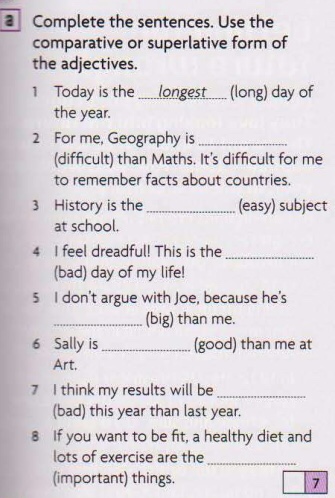
Fill in the correct form of the words in brackets (comparative or superlative).
My house is (big) bigger than yours.
This flower is (beautiful) more beautiful than that one.
This is the (interesting) most interesting book I have ever read.
Non-smokers usually live (long) longer than smokers.
Which is the (dangerous) most dangerous animal in the world?
A holiday by the sea is (good) better than a holiday in the mountains.
It is strange but often a coke is (expensive) more expensive than a beer.
Who is the (rich) richest woman on earth?
The weather this summer is even (bad) worse than last summer.
Each year, December 15th also recognizes National Cupcake Day. The cupcake was originally known as the 1-2-3-4 cake because the recipe called for 1 cup of butter, 2 cups of sugar, 3 cups of flour, 4 eggs, and also 1 cup of milk, and 1 spoonful of baking soda. Even the word cupcake sounds like a miniature celebration. They’ve been known by other phrases that make us put our hands together in glee, too! For example: Fairy Cakes Patty Cakes Cup Cakes (different from Cupcakes (one-word) Someone must have wanted to surprise a loved one with a sweet, single-serving treat when they invented the cupcake. One of the first recipes for a cupcake can be traced back to 1796. A recipe notation for a cake to be baked in small cups was written in American Cookery (by Amelia Simmons). Don’t you wonder if she made them for her children or grandchildren? The earliest known documentation of the term cupcake shows up in 1828 in Seventy-five Receipts for Pastry, Cakes, and Sweetmeats. The cookbook was by Eliza Leslie. Maybe she just liked individual servings. Bakers originally baked cupcakes in heavy pottery cups. Today, some bakers still use individual ramekins, small coffee mugs, larger teacups, or other small ovenproof pottery-type dishes for baking their cupcakes. They do make a beautiful presentation for these miniature cakes. Today, cupcakes are an artform. Bakers create elaborate decorations and displays utilizing a variety of ingredients. Whether they’re the centerpiece of a wedding, birthday, or anniversary cupcakes satisfy everyone’s sweet tooth. Colorful and fun, these single-serving delights offer a pleasing option when planning any celebration. The single-serve cake makes it convenient for serving and sharing. Today there are a variety of recipes and just as many flavors to choose from.
HOW TO OBSERVE #NationalCupcakeDay
When it comes to celebrating National Cupcake Day, you are only limited by your imagination. For the bakers out there, it is time to make a batch of your favorite cupcakes. Some bakers may want to step out of their routine and bake something new. Have you been hankering to spice up your cupcakes a bit? Sometimes we need an explosion of flavor or a little extra sparkle in our baking. Since cupcakes are such a simple recipe, it is also an excellent time to invite the kids into the kitchen. They will love mixing and decorating their individual cakes. That’s what’s so special about a cupcake. Another great way to celebrate National Cupcake Day is sending a shout out to your local bakery. They will be baking up batches of colorful and flavorful cupcakes! Be sure to stop in and pick up a dozen to share. Let them know how much you appreciate them, too. While you’re baking or shopping, be sure to share your favorite cupcake flavors. There are just so many to choose from! If you’re looking for recipes, we have a couple of delicious ones for you to try, too. Don’t forget to take a picture and share it on social media, too!
As in the case of many other complex, systemic inventions, the development of the idea of an electric car and its design took place in several stages, so it is very difficult to say when the first electric car was created and to single out the inventor who made the main contribution.
The first patent for an electric vehicle was issued already in 1799 in Great Britain [1], but this was only an idea, not a workable design, because the current source and electric motor had not yet been created. But a year later, thanks to the efforts of the Italian physicist Alessandro Volta, a current source appeared — the famous «voltaic pillar» — a primary chemical current source, consisting of more than a hundred copper and zinc plates, separated by cloth, which was impregnated with acid. Like modern batteries, the plates required periodic replacement (they dissolved). The very first electric vehicles received such batteries.
The principle of converting electrical energy into mechanical energy was shown by the British scientist Michael Faraday in 1821 in an experiment with a free hanging wire dipped in mercury. A permanent magnet was installed in the middlebaths with mercury. When a current was passed through the wire, the wire spun around the magnet, indicating that the current was causing a cyclic magnetic field around the wire. The development of this experience became a unipolar motor — Barlow’s wheel — a demonstration device that is of little use for practical use.
In an effort to create an electric motor for solving practical needs, the designers tried to imitate the principle of operation of a steam engine — the engine armature performed reciprocating movements. Scientist Boris Yakobi (Russia, Prussia) took a different path, creating in 1834 the world’s first practically usable electric motor with a rotating armature and published a theoretical work «On the use of electromagnetism to drive a machine.» With this invention, everything was ready for the creation of an electric vehicle.
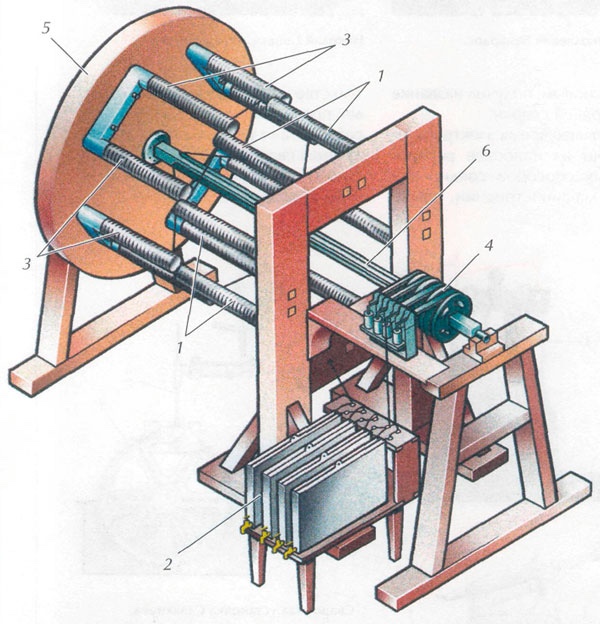
Jacobi engine Fixed group of U-shaped magnets (1) — the stator is powered by current directly from the galvanic battery (2); the direction of the current in the magnets remains unchanged. Movable group of electromagnets (3) — the rotor is connected to the battery through a commutator (4), with the help of which the current in the magnets and, therefore, their polarity change eight times during one revolution of the disk (5). Moving magnets are alternately attracted and repelled from the stationary ones, and the motor shaft (6) begins to rotate. The motor power is about 15 W.
And the appearance of the world’s first electric car was not long in coming: in the early thirties of the XIX century (the exact date is unknown), the Scotsman Robert Anderson built an electric model, which is considered the first in history. In 1835, the Dutch professor Sibrandus Stragingh and Thomas Davenport from Vermont (USA) made another electric car model. In 1842, the Scotsman Robert Davidson and the same Davenport built cars that were no longer models, but could carry people [2]. The electric motor in the cart was powered by acid batteries (huge baths with sulfuric acid) [3]. Davidson’s carriage was extremely slow, huge and clumsy, which, however, was typical of most road vehicles of the time.
A significant impetus in the development of electric vehicles was the invention of the lead-acid battery by the Frenchman Gaston Planté in 1859. Operating electric vehicles with rechargeable batteries was much more convenient than replacing zinc plates. So in 1881, the electric tricycle of Charles Jeanteau (the inventor of the steering linkage) drove onto the roads of Paris, and in 1888 Ratcliff Ward launched an electric omnibus through the streets of London, starting the commercial use of electric vehicles. Note that the tram appeared in 1881, and the trolleybus — in 1882.
In 1889, engineer Ippolit Romanov created the first Russian electric car. A feature of Romanov’s two-seater electric car was its low weight. It weighed only 720 kg, while the Zhanto electric car weighed 1440 kg.
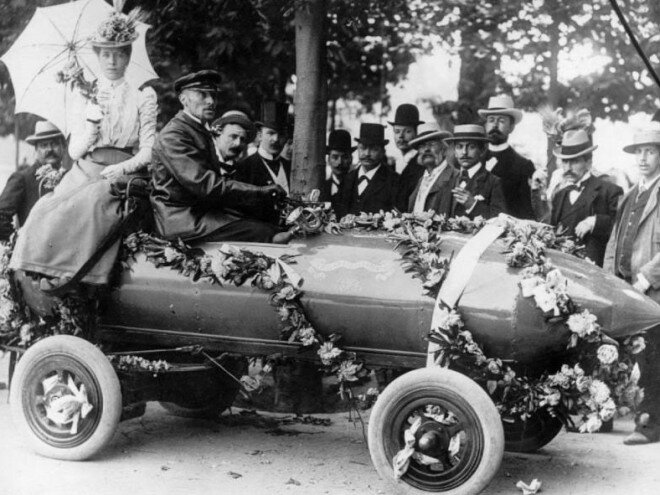
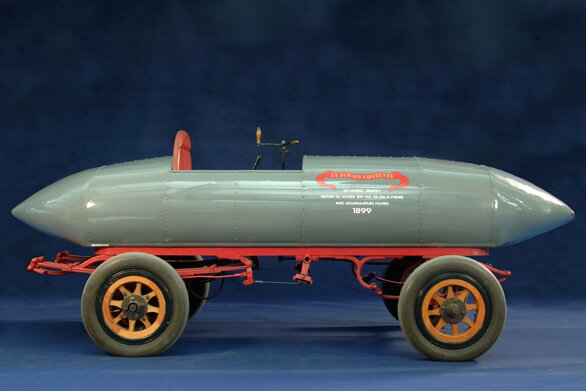
On May 1, 1899, in the town of Asher, near Paris, the Belgian racer-inventor Camille Zhanatzi brought to the start a homemade electric car «La Jamais Contente» (French for «Always dissatisfied»). It was in the shape of a projectile, the total power of its two electric motors was 50 kW (67 hp), and it was “shod” in pneumatic Michelin tires. The batteries were located on the chassis inside the body and on the rear axle. The maximum current strength is 250 A at a voltage of 200 V. The curb weight was about 1000 kg. Zhanatzi created the first car to overcome the 100-kilometer speed limit with a result of 105.9 km / h. This could not but contribute to the popularization of electric vehicles.
Electric car «La Jamais Contente» The first to overcome the speed of 100 km / h on land.
As a result, by 1900, more than half of the cars (including almost all taxis) registered in the United States were electric. However, by 1910, there were less than 1% of the total number of electric vehicles.
2.c 1. Lucy was doing a handstand. 2. Daniel and Sophie were playing table tennis. 3. Samuel was siting on the teacher’s desk. 4. Ken was writing a text message. 5. Lisa was dreaming about a day on the beach.
2.d
1. B: Was waiting, was buying 2. A: Did you talked, B: was telling 3. A: Were his parents living, B: were living, was working 4. A: Were you watching, B: was reading 5. A: Were you having, B: were talking 6. A: Were you playing, B: I wasn’t playing, I was doing 7. A: Were they wearing, B: weren’t wearing, were wearing
In 1903, Mary Anderson and a friend were driving to New York. It was raining heavily and they had to open the windows to their car and put their heads out to see better. Suddenly Mary had an idea. In 1869, Thomas Adams was trying to produce rubber out of the juice he got from Mexican sapodilla trees. He wanted to produce toys, rain boots and bicycle tyres. The experiment didn’t work. While he was thinking about this, he took a piece of the rubber he was working with and put it in his mouth. In 1897, British inventor James Henry Atkinson was looking at the family’s supply of potatoes, which they kept in a room under their house. He noticed that mice had eaten some of the potatoes so he invented something that he called ‘Little Nipper’ to stop them. In 1886, Josephine Cochran was standing in her kitchen in lllinios, USA. The family lunch was finished. There was a mountain of dishes in front of Mrs Cochran and she got quite angry, thinking that she had to do this job every day. ‘If nobody else is going to invent a machine for this, I’ll do it myself,’ she thought. In the early years of the eighteenth century, in the middle of the summer, an unknown Dutchman was looking at one of the many canals in Holland. He was thinking that he often travelled along the frozen canals on ice skates in the winter. He got a little impatient. ‘I don’t want to wait for winter!’ he thought.
She has never let her daughter have a boyfriend.2) Have you already read today’s newspaper?3) The house has been sallt.4) He has lose his wallet again.5) I have wrote three essays this week.6) That clock was made in Switzerland.7) He had ran 6 miles when he hurt his ankle.8) I have never saw such a beautiful view.9) He has a tough hundreds of students during his career.10) Have you ever met a famous person?11) Because she hadn’t pay the bill, the electricity went off.12) They have sent Christmas cards to all their friends.13) Where have we put the car keys?14) We have never song in public before.15) She had wore her blue dress many times.16) John had never spook English before he came to London.17) Why have you (stood) up – are we leaving?18) Have you ever swum in the Atlantic Ocean?19) It had took three hours to reach the station, so they had missed the train.20) I have never said that I didn’t love you.21) David jumped into the air. He had sat on a drawing pin.22) The weatherman had tall us it would be sunny, but it rained all day23) I’m sorry I’m so tired. I haven’t slept .24) Have you thought about changing jobs?25) He’d thought he had understood but now he realised he’d made a mistake.
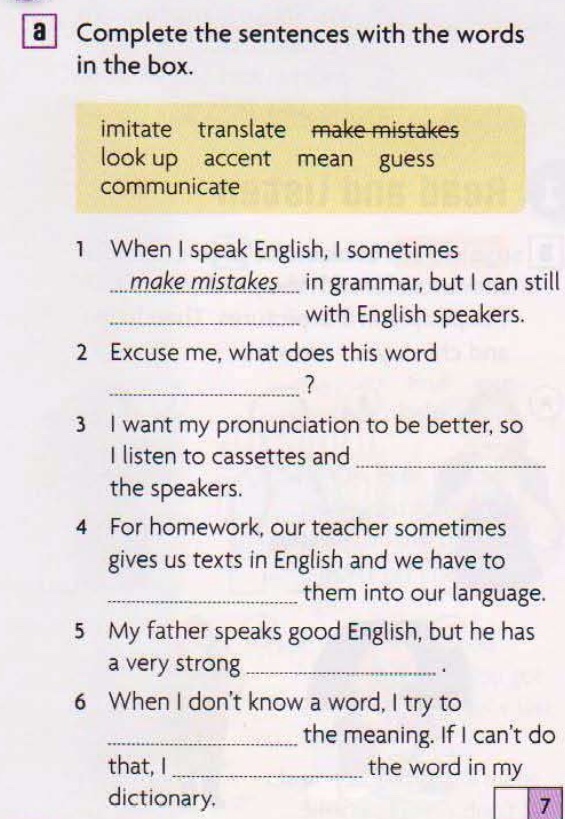
1 Make mistakes, communicate 2 Mean 3 Imitate 4 Translate 5 Accent 6 Guess, look up
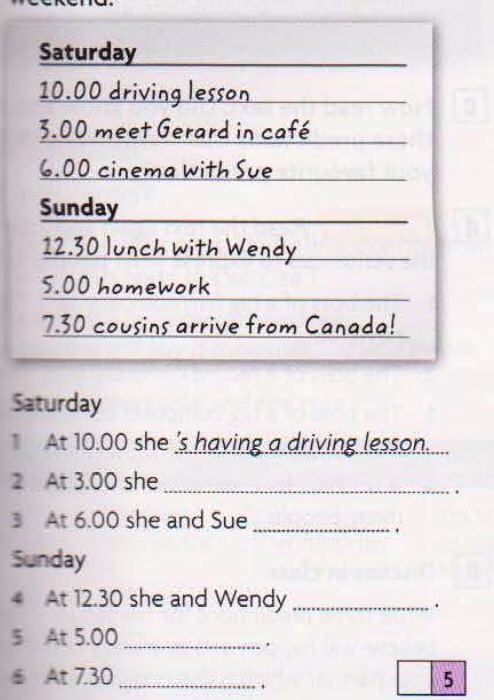
2 At 3.00 she has to meet Gerard in cafe. 3 At 6.00 she and Sue are going to cinema. Sunday 4 At 12:30 she and Wendy have a lunch. 5 At 5:00 she’s doing a homework. 6 At 7:30 her cousins are arriving from Canada!
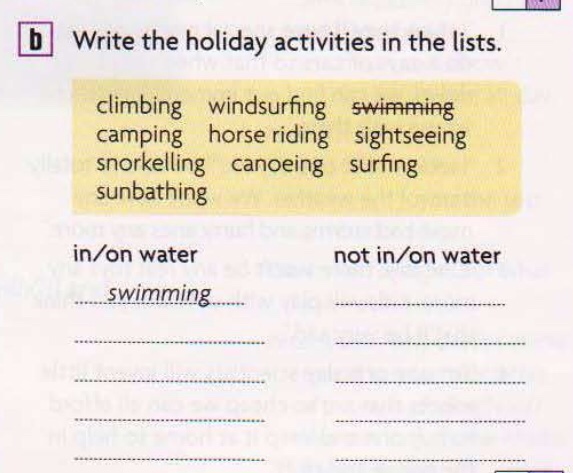
in/on water Swimming Snorkelling Windsurfing Canoeing Surfing Not in/on water Climbing Camping Sunbathing Horse riding Sightseeing
Armenians have a strong and remarkable connection to God. As we are the first country to embrace Christianity in 301 AD, we keep the religious traditions and customs that came from many years.In the easter we are makeing rice with raisins and eggs.









 Մարկ Հարությունյան